
The Thought You've Never Told Anyone
If a scary thought about your baby has ever crossed your mind and left you shaken, this is the post you've been too afraid to search for.

Picture this: you're standing at the top of the stairs, baby in your arms, and for half a second your mind shows you something you never asked to see — a fall, a slip, something going wrong.
You blink. You grip the baby a little tighter. And then you shove that thought so far down you're not even sure it really happened.
It happened. Therapists call these postpartum intrusive thoughts, and you probably haven't told a single soul.
Maybe it wasn't the stairs. Maybe it was the bathtub, or the knife on the counter, or a moment in the car when your hands went cold. Maybe it wasn't even a picture — just a flash of “what if” that made your stomach drop.
And underneath it, a question you haven't said out loud to anyone: What does it mean that my brain went there? Am I secretly capable of something terrible? Is this the sign that something is really wrong with me?
Here's the truth almost nobody says out loud: you are not alone, and that thought does not mean what you're afraid it means.

You're in Very Crowded Company
In one large study of new mothers, nearly all reported unwanted thoughts of their baby being accidentally harmed, and more than half reported unwanted thoughts of harming the baby on purpose.¹
Not want. Not a plan. Experience. Uninvited, unwelcome, and gone almost as fast as it arrived.
That means the thought that made you feel like a monster is, statistically, closer to a universal postpartum experience than a rare, dangerous one.
Researchers who study these thoughts have found that, on their own, unwanted thoughts of harming a baby don't appear to raise the likelihood of actually doing so. (Source: Fairbrother / UBC)
Why Nobody Talks About This
Nobody talks about it because saying it out loud feels like handing someone proof that you're a bad mother — the opposite of what you actually are.
The truth runs the other direction. Intrusive thoughts show up precisely because you love this baby so much that your brain is scanning for every possible threat, all day, on almost no sleep. The thought isn't a wish. It's a symptom of how much you care, misfiring under the weight of exhaustion, hormones, and a fear you can't fully turn off.
Silence is what keeps this thought feeling dangerous. Saying it — to a friend, a partner, a therapist — is usually the moment it starts to lose its grip.
A therapist who works with new moms knows the difference between an intrusive thought and intent. Hearing these thoughts is part of the job, not a reason for alarm.
The Difference Between a Scary Thought and a Warning Sign
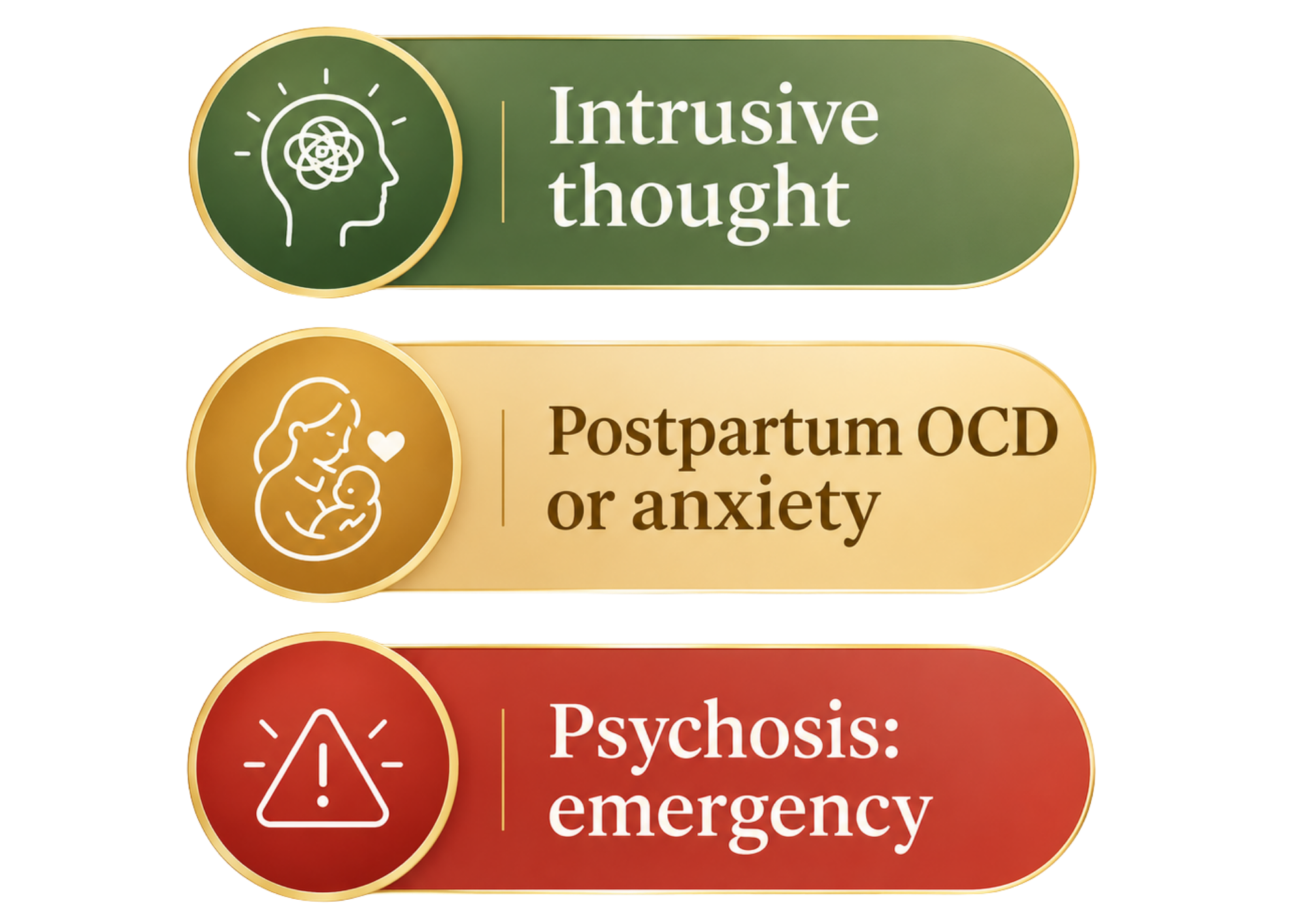
This is where it matters to know the difference, because these three things are not the same — and treating them the same only adds to the fear.
A thought that scares you, that you don't want, and that you'd never act on? That's a normal intrusive thought. It's common, it's treatable when it lingers, and it does not mean you're a danger to your baby.
Thoughts that won't stop looping, or a heaviness that won't lift — paired with checking, avoiding, constant worry, or feeling flat and not like yourself? That may be postpartum depression, postpartum anxiety, or OCD — common, highly treatable, and nothing to be ashamed of. This is where therapy can make a real difference.
Thoughts that feel like they aren't fully yours, paired with confusion, hallucinations, or a loss of touch with what's real? That's Postpartum Acute Mental Health — rare, affecting an estimated 1 to 2 out of every 1,000 births, and it's a medical emergency, not a therapy-first situation. It needs immediate care.
If this sounds like you, or someone you love, don't wait. Call 911, go to the nearest ER, or call or text 988 now.
What About Postpartum Depression?
Intrusive thoughts and postpartum depression aren't the same thing. But because both are so common, they can show up in the same mom, in the same season — and a lot of moms never connect the dots.
Postpartum depression (PPD) doesn't always look like crying on the couch. It can look like irritability or rage, constant worry, feeling numb or far away from your baby, sleep or appetite changes that a newborn schedule doesn't explain, or a quiet sense that you're just not yourself. According to CDC data, about 1 in 8 women with a recent live birth report symptoms of postpartum depression.2
Some weepiness and mood swings in the first couple of weeks are the baby blues — very common, and they usually ease with rest, support, and time. Postpartum depression is different. It's heavier, it lasts longer than two weeks, or it gets worse instead of better.
Here's what I want you to hear: postpartum depression is common, it's treatable, and it is not a character flaw or a lack of faith. You don't have to white-knuckle your way through it. Asking for support isn't weakness — it's wisdom.
And if the heaviness ever turns into thoughts of hurting yourself, or a feeling that your family would be better off without you, please don't wait. Call or text 988 right now.
Not sure whether this is the baby blues, postpartum depression, or something more? Our free guide walks through it.
Before You Decide Something Is Wrong With You, Ask Yourself
Does the thought scare you, or does it comfort you? Fear is the signal that it's an intrusive thought, not a desire. Comfort or relief would be a different, more urgent conversation — one to have with a doctor right away.
Do you want the thought to stop, or do you want to act on it? Wanting it gone is the normal response. If any part of you doesn't want it to stop, tell someone today, not eventually.
Are you pulling away from your baby, or checking and re-checking to keep them safe? Either can happen with intrusive thoughts, and both are common signs of postpartum anxiety or OCD, not signs that you're dangerous. They're also the best reason to talk to someone sooner.
Beyond the thought itself, how have you been feeling most days? If the answer is heavy, numb, or not like you — and it's lasted more than two weeks, or it's getting heavier instead of lighter — that's worth a conversation. It may be postpartum depression, and you don't have to push through it alone.
What Actually Helps
• Tell one safe person: a partner, friend, doctor, or therapist. Saying it out loud takes away much of its power.
Don't fight the thought. Pushing hard against it tends to make it louder. Notice it and let it pass.
Watch for checking and avoiding. Those habits keep the fear going, and they're what therapy helps loosen.
Ask for help sooner, not later. Therapy, including CBT-based approaches, works well for postpartum depression, anxiety, and OCD.

Final Thoughts
The thought you've never told anyone doesn't make you a danger. It makes you a tired, loving, overwhelmed new mother whose brain is working overtime to protect a baby she adores.
You don't have to carry it alone, and you don't have to wait until it gets unbearable to say it out loud. The moment you tell someone is usually the moment it starts to shrink.
If this is the first time you've let yourself read the words “intrusive thoughts” without flinching, that's not nothing. That's the beginning of relief.
If you want a simple way to tell the baby blues from postpartum depression (and from something more), our free guide, “Is This the Baby Blues — or Something More?”, is a good next step. No pressure, no diagnosis required.
And if you're ready to say the thought out loud to someone who won't flinch, I'd be honored to be that person. I see moms in our San Diego office and online across California, and I'm currently accepting new clients.

Tiffany Mead, LMFT specializes in helping moms and families navigate life's biggest transitions with warmth, creativity, and hope — including the disorienting early season of motherhood. If what you've read here sounds familiar, you don't have to sort it out on your own.
Tiffany sees clients in our San Diego office and online across California, and is currently accepting new clients.
Tiffany Mead LMFT #164562.
If you or your baby may be in immediate danger, call 911 or go to your nearest emergency room. If you're in crisis and need to talk to someone right now, call or text 988 (Suicide & Crisis Lifeline). For support or information any time, call or text the National Maternal Mental Health Hotline at 1-833-852-6262 — free and confidential, 24/7.
This blog is for informational purposes only and does not constitute therapy, clinical advice, or a therapeutic relationship.
Integrity Counseling Group — Clinical Excellence through a Christian Lens.
¹Collardeau, F., et al. Prevalence and Course of Unwanted, Intrusive Thoughts of Infant-Related Harm. Journal of Clinical Psychiatry.
Sources: Collardeau et al., Prevalence and Course of Unwanted, Intrusive Thoughts of Infant-Related Harm (Journal of Clinical Psychiatry) | Fairbrother et al. (2022), Postpartum Thoughts of Infant-Related Harm and OCD (Journal of Clinical Psychiatry) | UBC study summary (Neuroscience News) | UBC Department of Psychiatry, Dr. Nichole Fairbrother profile | HRSA National Maternal Mental Health Hotline